Not every custom design starts with a photograph. Some start with an idea.
Most people hear "custom design" from a photographer and picture the same thing: a photo, dropped onto a template, with team colors and a name added. That's a real product, and a good one — but it's not the only one, and lately it's not the one getting the most attention.
The piece leading this post is "Built Different," built for BRHS Panther Wrestling. It's not a composite. It's original concept artwork — an athlete rendered half as himself, half as the machine the training is meant to build, laid over a technical blueprint aesthetic built specifically for the program. Nobody handed me a template for this. It started as an idea and went through real development before it became a finished piece.
A composite records a season. A concept explains what it built.
Here's what that process actually looks like — and how it's different from the standard composite work most people are picturing.
It starts with a concept, not a photo
A composite starts at the camera. A piece like "Built Different" starts somewhere else entirely: with a question. What's the story this program or athlete is actually trying to tell? "Built Different" came out of a simple idea — that the difference between a good wrestler and a great one isn't visible, it's built through repetition most people never see. Once that idea existed, the visual language followed: a blueprint, because the piece is literally about what someone is built from; a half-human, half-mechanical figure, because it makes the idea of "training builds you into something else" literal instead of abstract.
That's concept development, and it happens before any design software opens. It's the part of the process that has no equivalent in a standard composite, because a composite doesn't need an original idea — it needs a good photo and a clean layout.
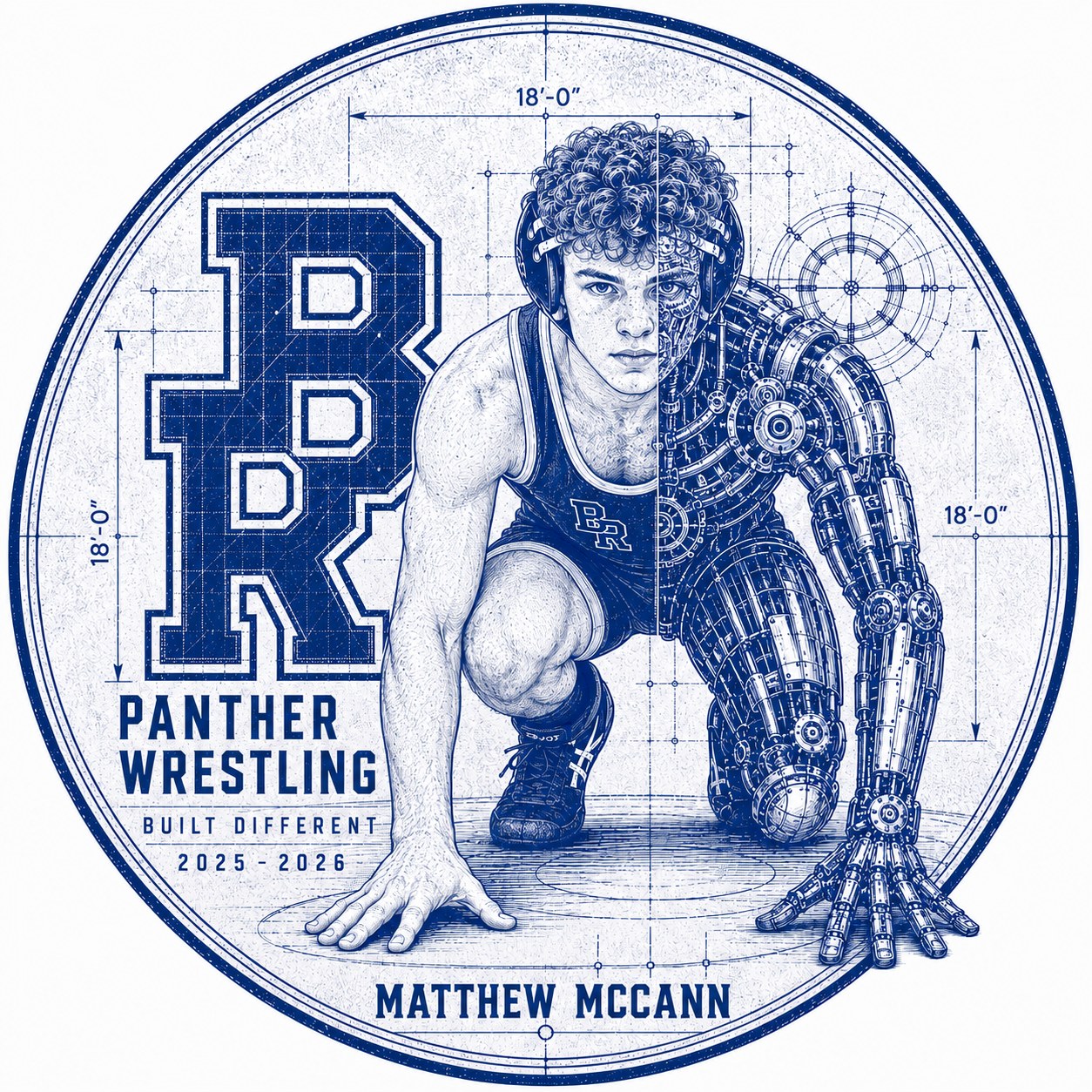
"Built Different" — the finished concept piece, in full. Click the image to view it at full resolution. Blueprint framing, program branding, and the half-human, half-mechanical figure built around Matthew McCann, BRHS Panther Wrestling.
Iteration is the actual job
The version that ships is never the first version. A concept piece like this goes through real iteration — different visual metaphors tested and discarded, different compositions tried before one earns its place, details refined based on what actually reads at full size versus what only worked as a small mockup. Some directions get built out significantly before getting scrapped entirely, because they looked right in an idea and wrong on the page.
This is the part of design work that's invisible in the final product and is also most of where the time actually goes. A finished concept piece represents the one direction that survived that process, not the first thing that got tried.
Then it becomes real feedback, not a guess
Before a piece like this is called finished, it gets tested against the audience it's actually for — does the concept land with the athlete and the program, or does it need another pass? That feedback loop is what separates a piece that looks good to a designer from one that actually resonates with the team, the coach, and the recruiting audience it's ultimately built for. Kyle Murphy, head coach of BRHS Panther Wrestling, said it plainly after seeing the finished work:
"The quality of his photography and graphic design work has taken BRHS Wrestling's social media presence to another level — his graphics consistently look sharp, professional, and engaging." — Kyle Murphy, Head Wrestling Coach, BRHS
That reaction is the actual goal. Not "that's a nice photo" — "that's something we're proud to put our name on."
What this costs, and why it's not the same number as a composite
Concept and campaign artwork like "Built Different" starts at $450, with multi-athlete campaigns and full program series scoped and quoted individually based on what the concept actually calls for. That's a different number than a standard composite for a real reason: a composite is built from a session's existing photos and a proven layout process. A concept piece is original development, iteration, and testing, built from nothing but an idea. The design time isn't comparable, so the price shouldn't be either. If you're weighing which one fits your program, reach out and we'll scope it honestly rather than upsell you into more than the project needs.
Where the standard composite still fits
Not every senior needs a fully original concept — and most don't need one. A standard composite is still the right product for a family that wants a strong, clean poster built from a senior portrait session or sports coverage: real gear and action shots from the shoot, laid into a design built around the athlete's sport, team colors, and graduation year, with two rounds of revisions included. It starts at $75, with team and bulk pricing available for programs ordering multiple, and it's still one of the most requested add-ons to a senior portrait session. If your senior plays a fall sport, pair it with a fall portrait session and bring the uniform — the same afternoon produces both.
The distinction that actually matters
"Custom design" covers two genuinely different products: a composite built from your photos, and original concept artwork built from an idea. Knowing which one you're asking for — and which one a project actually needs — is the difference between a fair price and a confusing quote.
Medals end up in a drawer. Uniforms get outgrown or handed down to the next kid on the roster. What doesn't fade is the piece that actually explains what a season meant — not just a photo from it, but the idea behind it. That's what a concept piece is built to outlast.
See the full Design portfolio or reach out to talk through which one fits what you have in mind.